Essential Information Services for Your Austrian Journey
MotorwayHelp Austria provides comprehensive information and guidance for navigating various roadside incidents and emergencies in Austria. Our resources are designed to equip you with the knowledge needed to react safely and effectively in challenging situations.
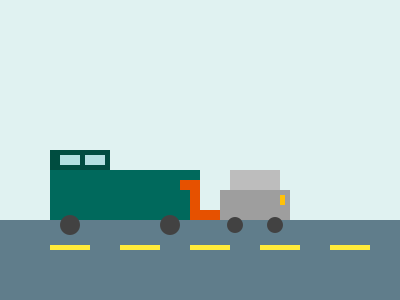
Motorway Emergency Procedures
Understanding the correct steps to take when your vehicle breaks down or you encounter an incident on an Austrian motorway is crucial for your safety and the safety of others. Our guidance covers everything from initial hazard warning to communicating with emergency services.
Scenario: Flat Tire on the A1 Motorway
You're driving on the A1 near Salzburg and suddenly experience a flat tire. What's the immediate protocol?
- Safe Stopping: Signal, pull over to the hard shoulder as far right as possible. If no hard shoulder, try to reach the next exit or a designated emergency stopping bay.
- Hazard Warning: Turn on your hazard lights immediately.
- Personal Safety: Put on your reflective safety vest before exiting the vehicle.
- Warning Triangle: Place the warning triangle at least 100 meters behind your vehicle on motorways, positioned to be visible to approaching traffic.
- Passenger Safety: Ensure all passengers exit the vehicle from the right-hand side (away from traffic) and wait behind the crash barrier if present.
- Contacting Help: Use an emergency call box (SOS Säule) if available, or your mobile phone to call the breakdown service. State your exact location (motorway number, direction, kilometer marker if visible).
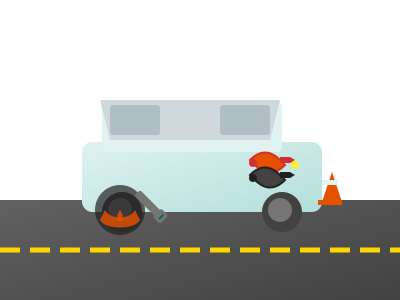
Accident Reporting Guidance
Navigating the aftermath of a road accident can be stressful. Our information helps you understand the legal requirements, reporting procedures, and how to gather necessary evidence in Austria.
Scenario: Minor Fender Bender in Graz
You've had a minor collision with another vehicle in urban Graz. No injuries, but visible damage. What next?
- Safety First: Secure the accident site with hazard lights and, if safe to do so, a warning triangle. Move vehicles to the side of the road if they impede traffic and the damage is minor.
- Check for Injuries: Always check if anyone is injured. If so, immediately call the emergency services (112 or 144).
- Police Notification: For accidents involving injury or significant damage, or if the parties disagree, call the police (133). For minor damage where parties agree, police notification is not mandatory but can be beneficial for documentation.
- Information Exchange: Exchange personal details (name, address, phone), vehicle details (license plate, make, model), and insurance information with the other party.
- Documentation: Take photos of the accident scene, vehicle positions, damage to all vehicles, road conditions, and any relevant signs. Sketch the accident scene.
- Witnesses: Note down contact details of any witnesses.
- Accident Report Form: Fill out a European Accident Statement form (Unfallbericht) if available, or note down all details comprehensively.
Roadside Safety Protocols
Your safety is paramount. Our resources detail essential safety measures and equipment required by law in Austria, ensuring you're prepared for any roadside stop, planned or unplanned.
Scenario: Mechanical Issue in a Rural Area
Your car starts making strange noises and you decide to pull over on a rural road in Styria to investigate. How do you maintain safety?
- Safe Stop: Find the safest possible place to pull over, ideally off the main carriageway. Avoid blind corners or crests.
- Warning Signals: Activate hazard lights. If visibility is poor or it's dark, use extra caution.
- Safety Vest: Always wear a reflective safety vest when outside your vehicle on any road, especially if approaching traffic is present. This is a legal requirement in Austria.
- Warning Triangle Placement: Place the warning triangle at an appropriate distance (at least 50 meters on country roads, 100 meters on motorways) to give approaching drivers ample warning.
- Stay Visible, Stay Safe: If you need to check under the bonnet, ensure you are not standing in the path of traffic. If waiting for assistance, remain in a safe location, preferably behind a barrier or well away from the road.
- Children and Pets: Keep children and pets safely away from the roadway, ideally behind barriers or inside the vehicle if it's the safest option.
Assessment Factors for Roadside Assistance Providers
When evaluating options for roadside assistance, understanding what factors are important can guide your decision. This table outlines key considerations:
| Factor | Description / Consideration |
|---|---|
| Response Time | Average time from call to arrival at scene. Critical for safety and convenience. |
| Coverage Area | Geographic extent of services within Austria and potentially abroad. |
| Towing Distance | Maximum distance vehicle will be towed without additional charges. |
| Service Hours | Availability of services (24/7, specific hours, holidays). |
| Vehicle Types Covered | Cars, motorcycles, caravans, light commercial vehicles, electric vehicles. |
| Membership Cost | Annual fees, initiation fees, and any tiered pricing structures. |
| Roadside Repair Capability | Scope of minor repairs that can be performed at the breakdown site (e.g., jump starts, tire changes, fuel delivery). |
| Multi-Language Support | Availability of assistance in languages other than German, important for international visitors. |
| Winter Service Availability | Specific provisions for breakdowns in snow, ice, or extreme cold. |
| Payment Options | Methods accepted for non-covered services or pay-per-use scenarios. |
| Onward Travel/Accommodation | Provisions for alternative transport or overnight stays if repairs are extensive. |
| Legal Assistance/Advice | Availability of legal counsel or guidance following an accident. |
Preparation Before Requesting Road Assistance
Being prepared significantly speeds up assistance and enhances your safety. Use this checklist:
- Note your exact location (road name/number, direction, nearest town, kilometer marker if on motorway).
- Activate your vehicle's hazard warning lights.
- Put on your reflective safety vest before leaving the vehicle.
- Place the warning triangle at the legally required distance.
- Ensure all occupants are in a safe location, ideally behind a crash barrier.
- Have your vehicle's details ready (make, model, license plate number).
- If you have a membership, have your membership number readily available.
- Describe the nature of the breakdown or accident clearly.
- Be prepared to provide a contact phone number.
- If an accident, gather information from other parties and take photos.
- Consider any potential language barriers and how to address them.
- If it's cold, ensure you have warm clothing. If hot, ensure access to water.
Understanding Limitations and Exclusions
It's important to be aware of what roadside assistance typically covers and what falls outside the standard scope. This helps manage expectations and avoid surprises:
- Pre-existing Conditions: Breakdowns due to known, unresolved mechanical issues often fall outside coverage.
- Lack of Maintenance: Issues arising from neglected vehicle maintenance may not be covered.
- Non-Roadworthy Vehicles: Vehicles that are not legally roadworthy or registered may be excluded.
- Specialized Recovery: Complex recoveries requiring heavy-duty equipment (e.g., off-road recovery from ditches) might incur extra charges or require specialized providers.
- Acts of Nature/Vandalism: Damage from extreme weather, natural disasters, or vandalism often falls under vehicle insurance, not standard roadside assistance.
- Racing/Off-road Use: Breakdowns occurring during competitive events or intentional off-road driving are typically excluded.
- Non-standard Vehicles: Certain oversized vehicles, modified vehicles, or classic cars with specific needs might not be covered by standard plans.
- Repeat Call-outs for Same Issue: Frequent calls for the identical, unresolved issue within a short timeframe may be subject to additional charges.
- Costs of Parts/Repairs: Roadside assistance covers the service (e.g., towing, jump-start), not the cost of replacement parts or garage repairs.
- Self-Inflicted Damage: Damage caused by deliberate action or gross negligence of the driver.
Frequently Asked Questions
What are the mandatory safety items to carry in my vehicle in Austria?
In Austria, you are legally required to carry a reflective safety vest (for each person exiting the vehicle on the roadside), a warning triangle, and a first-aid kit in your vehicle at all times.
What should I do if my car breaks down on an Austrian motorway?
Immediately turn on your hazard lights, pull over to the hard shoulder as far right as possible. Don your safety vest, place the warning triangle 100m behind your vehicle, and move to safety behind the crash barrier. Then call for assistance, either via an emergency call box or your mobile phone.
Do I always need to call the police after a minor accident?
No, not always. If there are no injuries, all parties agree on the circumstances, and the damage is minor (property damage only), calling the police is not strictly mandatory. However, it is often advisable for documentation purposes, especially if you anticipate insurance claims or if there's any disagreement. Always call if there are injuries or significant damage.
How do I report an accident to the police in Austria?
You can call the police at 133 or the European emergency number 112. Be prepared to provide your exact location, details of the accident, and whether there are any injuries.
What is an "SOS Säule" and how do I use it?
An SOS Säule (emergency call box) is a direct line to emergency services on motorways and major roads. They are typically yellow or orange and spaced every 1-2 kilometers. Simply press the button, and you'll be connected to a control center that can pinpoint your location automatically, even if you don't know it.
Can I perform minor repairs on the hard shoulder?
While you might be able to change a flat tire, it is generally advised to wait for professional assistance on busy motorways due to the inherent danger. Only attempt minor repairs if it is absolutely safe to do so and you are well-protected behind a barrier. Your safety is the priority.
What information should I collect after an accident?
Collect names, addresses, phone numbers, vehicle registration numbers, insurance details (company and policy number) of all involved parties. Take photographs of the accident scene, vehicle damage, road conditions, and any relevant signs. Note down contact details of witnesses. Fill out a European Accident Statement if possible.
Is it safe to stay in my car while waiting for assistance?
On motorways, it is generally safer to exit the vehicle from the side away from traffic and wait behind the crash barrier. If there is no barrier or it's unsafe to exit, staying in the vehicle with your seatbelt fastened and hazard lights on might be a safer option, especially in adverse weather. Always assess the immediate situation for the safest choice.
What if I run out of fuel on the motorway?
Running out of fuel on a motorway is considered an avoidable breakdown and can sometimes incur a fine. Follow the same safety protocols as for any breakdown: pull over safely, activate hazard lights, put on your safety vest, place a warning triangle, and call for assistance. Many roadside assistance providers offer fuel delivery services.